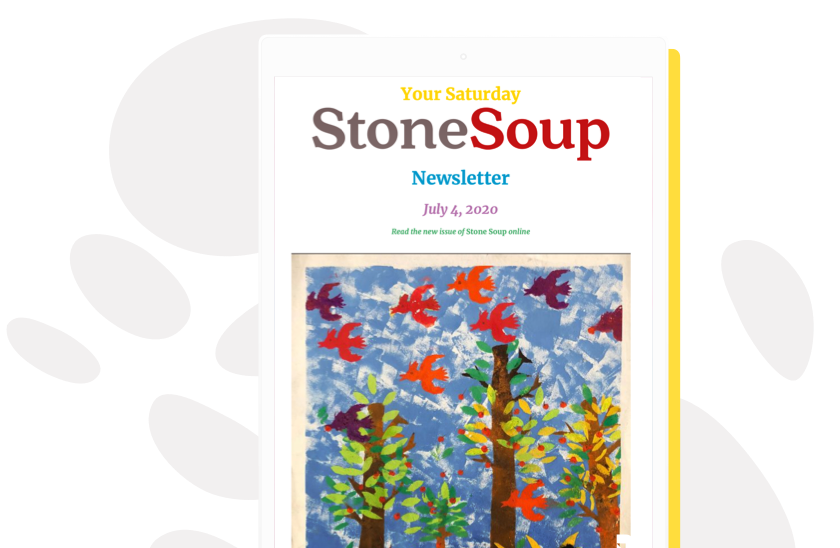
Introduction to this Stone Soup Art Activity For the artist, every workplace is a separate world with its own unique environment of light, sound, smell, and activity, and each picture is a story in line, shape, and maybe color that tells about that special place. The seven-year-old artist from Sri Lanka who painted the picture on the front cover did an excellent job of telling the story of a unique world she has seen, but that we may never see — the world of a tea plantation. Look at how she creates her picture world. She shows us the geography: the hills surrounding the plantation. She shows us the weather: clouds over the hills and a blue sky above. She shows us how the tea plants are arranged in rows, and she shows us the building that is a part of every tea plantation, the building where the tea leaves are sorted, fermented, and prepared for shipping to the world’s tea drinkers. In the middle of this scene she shows us a woman picking tea. She appears to be a young woman and has long hair. She is wearing a blue blouse, a red polka-dotted dress called a sort, and silver bracelets on both wrists. On her back she carries a large basket filled with tea leaves. The basket is undoubtedly heavy and the work is hard. Project 1: Working Outdoors Make a picture of someone working outdoors. You might make a picture of a gardener, a coach for soccer or baseball, someone building a building or working on a road, or a telephone repair crew. Sometimes you may work outdoors too, for instance, if you rake leaves, clear snow, or mow lawns. Through your picture tell as complete a story of the workplace as possible. Tell your story so that someone from another country who doesn’t know anything about the place you live, or about the people who work there, will understand what you have seen. Remember to show what type of clothing the workers are wearing, and, if they are using tools, include them in your picture. Project 2: Working Indoors Make a picture of someone working indoors. That might be someone in an office, or a store, at your school, or in a factory. Or it might be a picture of you or one of your parents working around the house. The interior of a building has a very different feel from a place outside. Instead of the sky, there is a ceiling. Instead of the sun, there are electric lights. Instead of trees and plants growing in the ground, there are (maybe) plants in pots. As with your outdoor picture, remember to show what the people look like, what type of clothes they are wearing, and what tools they use, if any, at their job. Harvesting Tea, by Achinda Siriwardena, age 7, Sri Lanka
Teacher Resources
Writing Activity: reward a likeable character, with “Doll Shop Magic” by Joanna Calogero, 13

Introduction to this Stone Soup Writing Activity This writing activity is based on a story by 13-year-old Joanna Calogero published in Stone Soup Magazine’s September/October 1992 issue, and also included in the Stone Soup Book of Fantasy Stories anthology. Read the story, “Doll Shop Magic,” on our website here. Joanna’s story is a fairy tale, a story in which a supernatural force rescues a good person from a desperate situation. While it is a fairy tale, it is a modern fairy tale. The action takes place in a big city among people who all act and think like average modern people. In fact, while it is pretty clear that something very magical happens in this story to save the main character, Sam, from his landlord, Mr. Murphy, Sam is never sure what saves him. Maybe it was just luck. Maybe the girl and the doll were a dream. Sam, like most modern people, doesn’t believe in fairies. Notice how thoroughly Joanna develops the reality of Sam’s life and problem. His city has changed, his doll store is no longer in the part of town where people shop, and the new landlord, like the city itself, is no longer friendly or tolerant. The modern city doesn’t encourage romance and magic. And so, throughout this story, the question remains unanswered: Did more than just good luck enter Sam’s life? Project: Write a Story in Which a Likeable Person Is Rewarded Through Magic or Luck Your character does not have to be perfect, just likeable. But your character should be struggling against a mean or uncaring person. In traditional fairy tales the bad person is very bad: typical examples include an ogre, an evil stepmother, or an evil witch. In Joanna’s story, “Doll Shop Magic,” Mr. Murphy, the landlord, plays the role of the more traditional evil fairy tale character. But Mr. Murphy is not really bad, like a criminal or an ogre. He is bad the way the modern world is bad. He is insensitive, uncaring, and inflexible towards a fellow human being. In your story, show us how a kind person who desperately needs help finally gets it in an unexpected way. Whether the unexpected is clearly magical or whether it just seems a coincidence is up to you. Or, like Joanna, you can blur the edges between reality and fantasy so we never really know. Pay attention to the setting in which your story takes place so that no matter what happens you give the reader a sense that at least the place and the main character are real.
Writing Activity: make a fictional creature seem real, with “The Baron, the Unicorn, and the Boy” by Ogechi Cynthia Njoku, 12

Introduction to this Stone Soup Writing Activity Ogechi’s story, The Baron, the Unicorn, and the Boy, is about an ordinary boy, Albert, and how he is rescued from the boredom of a school outing by a dream-like adventure in a fairy-tale past. Ogechi’s writing is clear and forceful. Like all good fairy tales, her story can be read as a pleasant tale. The familiar elements — the kind, bewitched king, the lovely unicorn, the powerful ruby, and the arrogant baron — are like familiar friends or favorite foods that make for a satisfying few minutes’ entertainment. Also, though, like all good fairy tales, Ogechi’s story can be read on a deeper level. Albert was lost in a museum. But at some point in most people’s lives they feel themselves to be lost and without purpose. At those times it is natural to dream of adventure and radical change. This is the spirit behind the fantasy of daydreams. Rarely, but it does happen, adventure reaches into our ordinary lives as it reached into Albert’s. By some amazing chance we win a game when usually we are a terrible athlete. Or there is a hurricane or some other natural disaster and suddenly there is lots to do and we do it. Albert woke up from his adventure to find a necklace around his neck. Others wake up to find a trophy on their bedroom shelf or read about themselves in the morning paper. Did I really do that? Most of us are like Albert. The adventure suddenly appears in our life and when it is over we have little more than a memory and a souvenir. Project: Write a Story in Which an Ordinary Person Is Suddenly Involved in an Adventure and/or Fiction Becomes Real Whether your adventure is grounded in reality, like a sporting event or a natural disaster, or whether it is a fantasy, like Ogechi’s story, try to create a believable world. Ogechi’s treatment of the unicorn provides a model for how to make a fictional creature seem real. Notice that, in addition to mere physical descriptions, Ogechi show us the unicorn as a living, thinking creature. She does this by showing us how the unicorn and Albert communicate with each other. When writing your story, always remember that if you can show how living things relate to each other, through words, gesture, or even by some mystical tie, your imaginary world will seem real. The Baron, the Unicorn, and the Boy By Ogechi Cynthia Njoku Illustrated by Andrew Ujifusa Albert gazed listlessly at everything before him. Statues and tombs stood around him, both of great and delicate antiquity. People shuffled noiselessly past him, admiring the artifacts set before them. As you can imagine, Albert was at the museum. This was one of the numerous outings he’d been obliged to take part in during the school year. Thus, he was spending hours in the detested place. “Can we leave now?” he asked. His voice hung in the heavy silence, and, receiving no answer, he looked up to find himself alone. Panicking, he ran to the exit,thinking that his class had perhaps gone or moved on to another interesting display, but, instead of facing the usual glass panels, he found himself facing an old door. It was so gray with dust and veiled with cobwebs that Albert could hardly see it. Curiosity, with a thread of fear accompanying it, forced him to open it. He stepped over the threshold. The room was covered with layers of dust with an open grime-covered window showing glimpses of a barren and desolate land. The room was empty except for a large figure at one corner. Albert shivered and took a few steps backward. Just then something stirred and some dust brushed off the figure’s face. Its eyes blinked open and stared at Albert. He turned with his heart in his throat, his sole intention to run out of the place, when the voice arrested him. “At last you are here. I have waited for a long time.” Albert turned slowly and stared at the man, for man he was! While he was busy brushing himself off, Albert diligently studied him. He was young with stalwart features. His face was kind but with a hint of sadness and suffering hovering around it. His clothes suggested long ago prosperity but were now in rags. His limpid eyes lifted to meet Albert’s and he smiled. “I am Raymond Fitzgerald,” he said. “I am a king but have not seen much of that aristocratic world. At an early age, I lost my father and mother in tragic circumstances, indeed, there was a lot of mystery surrounding their death. I was made king, and, as young as I was, I was made to do a number of duties. In one of them, I was visiting a nearby kingdom. I took with me enough sustenance to last a month, my unicorn, and the baron. I once trusted. My unicorn was envied in many kingdoms for its strength and spirit. My baron, as I found out later, also liked it, and, halfway through the journey, he attacked me. Taken by surprise and totally unarmed as I was, he easily defeated me. He took my unicorn and kept me captive here. Even then…,” he shrugged. “Without that unicorn I am nowhere. Luckily, the baron informed me of the unicorn’s whereabouts, thinking that I’d never be able to reach it. The unicorn is in a cage situated about three miles from here. Give him this flower.” He withdrew a crushed flower from the tattered folds of his cloak. “It will enable him to free himself from the cage. Beware of the baron for he is very sly. You may use no arms as only the ruby can kill the baron. Do you agree?” Silence followed in which Albert trembled. His instinct told him that to agree was to sign his death sentence. But maybe he was thinking of the long-ago sense